
一.日程表
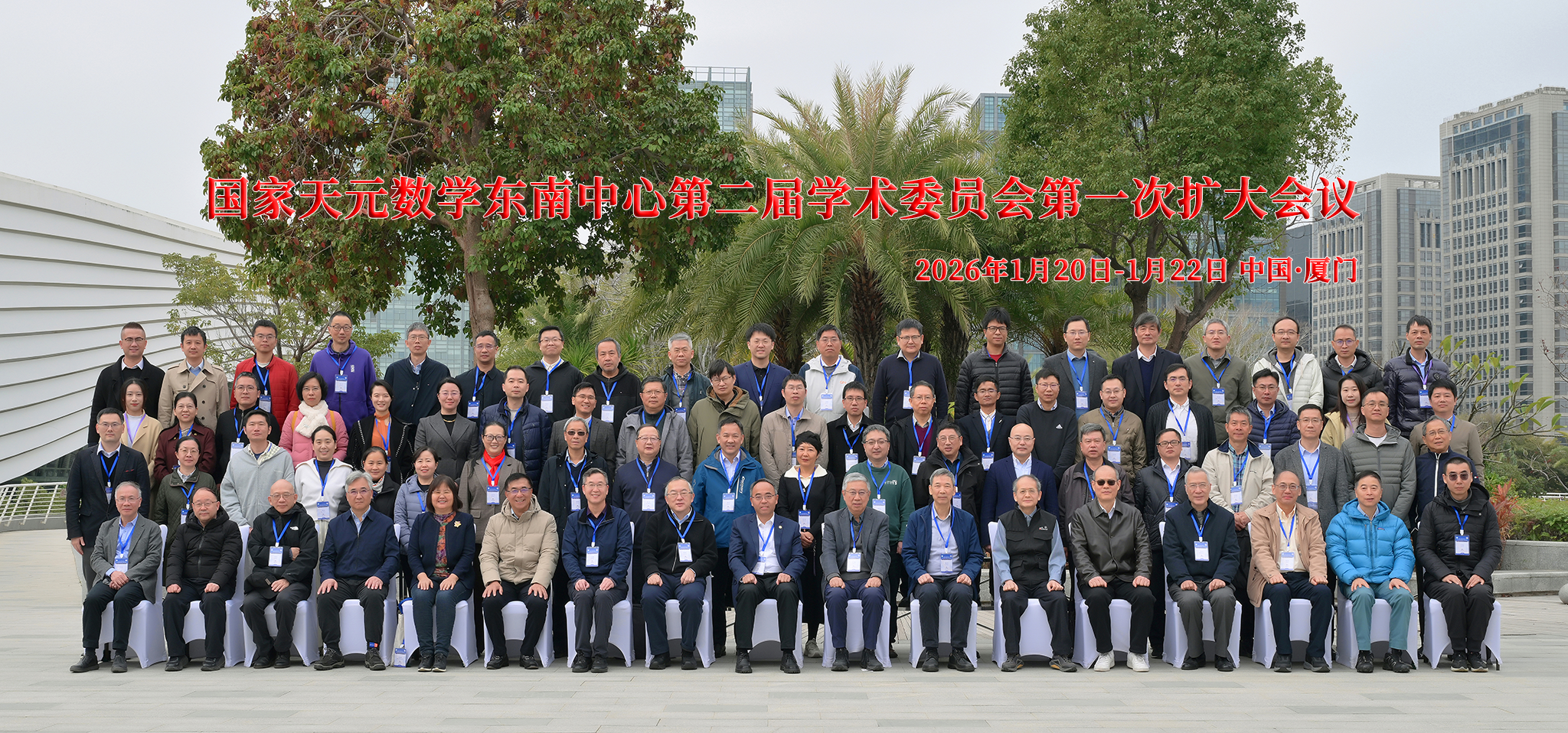
12月21日上午 | 09:00-09:10 | 合影、开幕式 | ||
主持人 | 邱建贤 | |||
09:10-09:40 | 焦雨领 | Generative Learning with Euler Particle Transport | 实验楼105 | |
09:40-10:10 | 黄 文 | Recursive Importance Sketching for Rank Constrained Least Squares: Algorithms and High-order Convergence | ||
主持人 | 杨志坚 | |||
10:30-11:00 | 张继伟 | 非局部到局部模型关于非局部参数的一致二阶收敛 | 实验楼105 | |
11:00-11:30 | 毛志平 | Physics-informed neural networks for high-speed flows | ||
12月21日下午 | 中心经验交流会 | |||
二.学术报告题目与摘要
Generative Learning with Euler Particle Transport
焦雨领(武汉大学)
Abstract: We propose an Euler particle transport (EPT) approach for generative learning. EPT is motivated by the problem of constructing the optimal transport map from a reference distribution to a target distribution characterized by the Monge-Ampere equation. Interpreting the infinitesimal linearization of the Monge-Ampere equation from the perspective of gradient flows in measure spaces leads to a stochastic McKean-Vlasov equation. We use the forward Euler method to solve this equation. The resulting forward Euler map pushes forward a reference distribution to the target. This map is the composition of a sequence of simple residual maps, which are computationally stable and easy to train. The key task in training is the estimation of the density ratios or differences that determine the residual maps. We estimate the density ratios (differences) based on the Bregman divergence with a gradient penalty using deep density-ratio fitting. We show that the proposed density-ratio estimators do not suffer from the “curse of dimensionality” if data is supported on a lower-dimensional manifold. Numerical experiments with multi-mode synthetic datasets and comparisons with the existing methods on real benchmark datasets support our theoretical results and demonstrate the effectiveness of the proposed method.
非局部到局部模型关于非局部参数的一致二阶收敛
张继伟(武汉大学)
Abstract: In this talk we focus on the uniform convergence rates from nonlocal models to the corresponding local models, and presents a necessary condition to guarantee the first-order and second-order convergence rate with respect to a nonlocal horizon parameter  without extra assumptions on the regularity of nonlocal solutions. To do so, we first revisit the maximum principle for nonlocal models, and present the uniqueness of the nonlocal solutions. After that, we give the methodology to address the truncated errors on the volume constrains or Neumann BCs, and then combine the resulting errors from boundary layers with the maximum principle to obtain the uniform convergence order. Our analysis shows that the constant value continuation of the boundary conditions of local problems only leads to first-order convergence rate. And if we expect to have second-order convergence rate, the information of first-order derivatives for local problems on the boundaries is required. One and two dimensional numerical examples are given to verify the effectiveness of our theoretical analysis.
Recursive Importance Sketching for Rank Constrained Least Squares: Algorithms and High-order Convergence
黄文(厦门大学)
Abstract: We propose a new Recursive Importance Sketching algorithm for Rank constrained least squares Optimization (RISRO). As its name suggests, the algorithm is based on a new sketching framework, recursive importance sketching. Several existing algorithms in the literature can be reinterpreted under the new sketching framework and RISRO offers clear advantages over them. RISRO is easy to implement and computationally efficient, where the core procedure in each iteration is only solving a dimension reduced least squares problem. Different from numerous existing algorithms with locally geometric convergence rate, we establish the local quadratic-linear and quadratic rate of convergence for RISRO under some mild conditions. In addition, we discover a deep connection of RISRO to Riemannian manifold optimization on fixed rank matrices. The effectiveness of RISRO is demonstrated in two applications in machine learning and statistics: low-rank matrix trace regression and phase retrieval. Simulation studies demonstrate the superior numerical performance of RISRO.
This is joint work with Yuetian Luo (UWM), Xudong Li (Fudan), and Anru R. Zhang (UWM)
Physics-informed neural networks for high-speed flows
毛志平(厦门大学)
Abstract: In this work we investigate the possibility of using physics-informed neural networks (PINNs) to approximate the Euler equations that model high-speed aerodynamic flows. In particular, we solve both the forward and inverse problems in one-dimensional and two-dimensional domains. For the forward problem, we utilize the Euler equations and the initial/boundary conditions to formulate the loss function and solve the one-dimensional Euler equations with smooth solutions and with solutions that have a contact discontinuity as well as a two-dimensional oblique shock wave problem. We demonstrate that we can capture the solutions with only a few scattered points clustered randomly around the discontinuities. For the inverse problem, motivated by mimicking the Schlieren photography experimental technique used traditionally in high-speed aerodynamics, we use the data on density gradient ∇ρ(x, t), the pressure p(x, t) at a subdomain as well as the conservation laws to infer all states of interest (density, velocity and pressure fields). We present illustrative benchmark examples for both the problem with smooth solutions and Riemann problems (Sod and Lax problems) with PINNs, demonstrating that all inferred states are in good agreement with the reference solutions. We also solve the inverse problem by combining the aforementioned data and the Euler equations in characteristic form, showing that the results obtained by using the Euler equations in characteristic form are better than that obtained by using the Euler equations in conservative form. Taken together, our results demonstrate that in the current form, where the conservation laws are imposed at random points, PINNs are not as accurate as traditional numerical methods for forward problems but they are superior for inverse problems that cannot even be solved with standard techniques.