
一、日程安排
日期 | 时间 | 事项 | |
3月31日 | 15:00-20:00 | 签到 | |
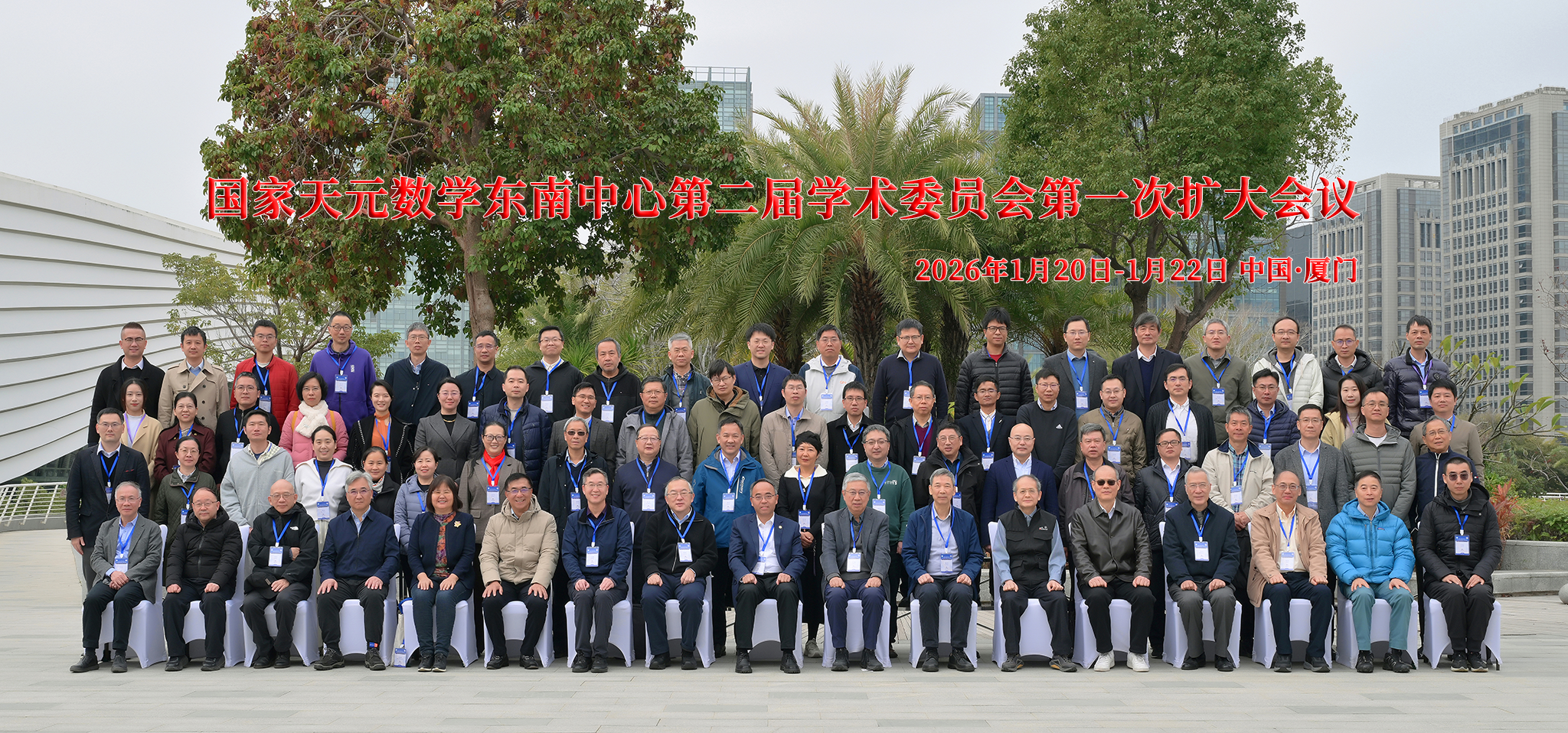
4月 1日 | 08:40-09:00 | 开幕式、合影 | |
主持人 | 邱建贤 | ||
09:00-09:40 | 李 竞: | Some New Progresses on Compressible Navier-Stokes Equations | |
09:45-10:25 | 成 娟: | High Order Multi-resolution WENO Schemes for Hamilton-Jacobi Equations on Moving Meshes | |
主持人 | 张剑文 | ||
10:45-11:25 | 杜力力: | Steady Collision of Two Jets Issuing from Two Axially Symmetric Channels | |
11:30-12:10 | 徐立伟: | High Order Time-domain Numerical Methods for Magnetohydrodynamic Equations | |
主持人 | 熊涛 | ||
14:00-14:40 | 杨志坚: | Boundary Condition for Dislocation Dynamic Simulation in BCC Crystal | |
14:45-15:25 | 谢 峰: | Global Solvability of 2D MHD Boundary Layer Equations in Analytic Function Spaces | |
15:25-16:05 | 张 磊: | 构建能量景观上的解景观
| |
主持人 | 王焰金 | ||
16:25-17:05 | 张 然: | Weak Galerkin Finite Element Method for Linear Elasticity Problem | |
17:10-17:50 | 江 飞: | Stabilizing Effect of Magnetic Field in the Well-posedness Problem of Inviscid MHD Fluids | |
4月2日 | 全天 | 自由讨论及离会 | |
二、学术报告题目与摘要
High Order Multi-resolution WENO Schemes for Hamilton-Jacobi Equations on Moving Meshes
成娟 北京应用物理与计算数学研究所
Abstract: In this talk, the high order multi-resolution weighted essentially non-oscillatory (WENO) schemes for Hamilton-Jacobi (HJ) equations on moving meshes are discussed. First, we will develop a high order arbitrary Lagrangian-Eulerian (ALE) WENO finite difference method for HJ equations, which is based on moving quadrilateral meshes. Next, we are concerned with the study of efficient and high order accurate numerical methods for solving HJ equations with initial conditions defined in the whole domain. Specifically, we use the above mentioned high order ALE-WENO finite difference scheme in a finite and moving computational domain, with numerical boundary conditions obtained by solving the characteristic ordinary differential equations along the artificial boundary of the moving computational domain. The usage of this moving characteristic boundary conditions allows us to solve the HJ equations in any initial finite domain that we are interested in, regardless of the magnitude of the initial condition at the artificial domain boundary. Numerical tests in one and two dimensions are given to demonstrate the flexibility and efficiency of our schemes on the moving meshes in solving both smooth problems and problems with corner singularities.
Steady Collision of Two Jets Issuing from Two Axially Symmetric Channels
杜力力 四川大学
Abstract: In this talk, we will discuss the mathematical theory on the steady collision problem, and introduce the well-posedness theory on hydrodynamic impinging outgoing jets issuing from two coaxial axially symmetric nozzles. More precisely, we showed that for any given mass fluxes in two nozzles respectively, that there exists an incompressible, inviscid impinging outgoing jet, which issues from two given semi-infinitely long axially symmetric nozzles and extends to infinity. Moreover, the constant pressure free stream surfaces of the impinging jet initiate smoothly from the mouths of the two nozzles and shrink to some asymptotic conical surface. Furthermore, we showed that there is no stagnation point in the flow field and its closure, except one point on the symmetric axis. Some asymptotic behavior of the impinging jet in upstream and downstream and geometric properties of the free stream surfaces are also obtained.
Stabilizing Effect of Magnetic Field in the Well-posedness Problem of Inviscid MHD Fluids
江飞 福州大学
Abstract: In this talk,I will introduce recent progress in the topic of stabilizing effect of magnetic field in the well-posedness problem of inviscid MHD fluids.
Some New Progresses on Compressible Navier-Stokes Equations
李竞 中国科学院
Abstract: We investigate the barotropic compressible Navier-Stokes equations with slip boundary conditions in a three-dimensional (3D) simply connected bounded domain, whose smooth boundary has a finite number of two-dimensional connected components. For any adiabatic exponent bigger than one, after obtaining some new estimates on boundary integrals related to the slip boundary condition, we prove that both the weak and classical solutions to the initial-boundary-value problem of this system exist globally in time provided the initial energy is suitably small. Moreover, the density has large oscillations and contains vacuum states. Finally, it is also shown that for the classical solutions, the oscillation of the density will grow unboundedly in the long run with an exponential rate provided vacuum appears (even at a point) initially. This is the first result concerning the global existence of classical solutions to the compressible Navier-Stokes equations with density containing vacuum states initially for general 3D bounded smooth domains. This is a joint work with Prof. Guocai Cai (Xiamen Univ.)
Global Solvability of 2D MHD Boundary Layer Equations in Analytic Function Spaces
谢峰 上海交通大学
Abstract: In this talk we will discuss the global well-posedness of solutions to Magnetohydrodynamics (MHD) boundary layer equations in analytic function spaces. When the initial data is a small perturbation around a selected profile, and such a profile is governed by an one dimensional heat equation with source term, we establish the global in time existence and uniqueness of analytic solutions to the two dimensional MHD boundary layer equations. It is noted that the far-field states are not required to be small initially, but decay to zero as time tends to infinity with suitable decay rates.
High Order Time-domain Numerical Methods for Magnetohydrodynamic Equations
徐立伟 电子科技大学
Abstract: Magnetohydrodynamic (MHD) equations are of great importance in sciences and engineering. In this talk, we present some high order time-domain numerical schemes, mainly based on decouple BDF or Crank-Nicolson schemes, for several kinds of magnetohydrodynamic equations, including incompressible MHD, resistive MHD, and two-phase MHD equations etc. Related theoretical and numerical results will be given to illustrate the accuracy of numerical schemes.
Boundary Condition for Dislocation Dynamic Simulation in BCC Crystal
杨志坚 武汉大学
Abstract: The movement of dislocations and the corresponding crystal plastic deformation are highly influenced by the interaction between dislocations and nearby free surfaces. The boundary condition for inclination angle which indicates the relation between a dislocation line and the surface is one of the key ingredients in the dislocation dynamic simulations. In this paper, we first present a systematical study on by molecular static simulations in BCC-irons samples. We also study the inclination angle by using molecular dynamic simulations. A continuum description of inclination angle in both static and dynamic cases is derived based on Onsager’s variational principle. We show that the results obtained from continuum description are in good agreement with the molecular simulations. These results can serve as boundary conditions for dislocation dynamics simulations.
构建能量景观上的解景观
张磊 北京大学
摘要:很多实际的应用问题都可以被归为计算数学中求解具有多个变量的非线性能量函数的极小值问题。这类多解问题的能量景观通常具有多个极小,那么如何寻找全局极小和如何找到不同极小之间的关系一直是计算数学领域的两个关键问题。在报告中,我们提出了一个新的解景观 (solution landscape) 概念。解景观描述了不同的极小被相应的一阶鞍点连接,低阶鞍点被相应的高阶鞍点连接,最终连接到一个最高阶鞍点的层次结构图。我们根据解景观的特征,利用发展的高阶鞍点动力学,通过向下搜索和向上搜索方法,可以高效地在能量景观上构建出完整的路径图。我们以软物质系统的液晶缺陷为例,利用Landau-de Gennes模型计算了受限向列相液晶的缺陷景观。
Weak Galerkin Finite Element Method for Linear Elasticity Problem
张然 吉林大学
Abstract:In this report, the weak Galerkin finite element (WG) method is used to solve the linear elastic equation. The linear elastic equation is a classical model equation. Due to its complex structure and the fact that some of its physical quantities need to meet certain conditions, many difficulties are encountered in the numerical calculation of the linear elastic equation. Among the three issues that scholars are generally concerned about are: 1. The particularity of the definition of strain tensor leads to the numerical format is difficult in satisfying the coercive property; 2. The numerical solution of the linear elastic problem has a certain parameter dependence, and the parameter is unbounded when the elastic body tends to be incompressible; Stress tensor has symmetry due to Newton's third law, while the numerical format that maintains the stress tensor symmetry is very difficult to construct. The WG method has the following advantages: it allows the use of arbitrary polygon meshes, allows the mesh to have hanging points, and the numerical format is easy to construct. This report talks about the WG method to answer the above three questions separately. Futhermore, WG method can be applied to the numerical simulation of aviation tires.