
Schedule
Title and Abstracts
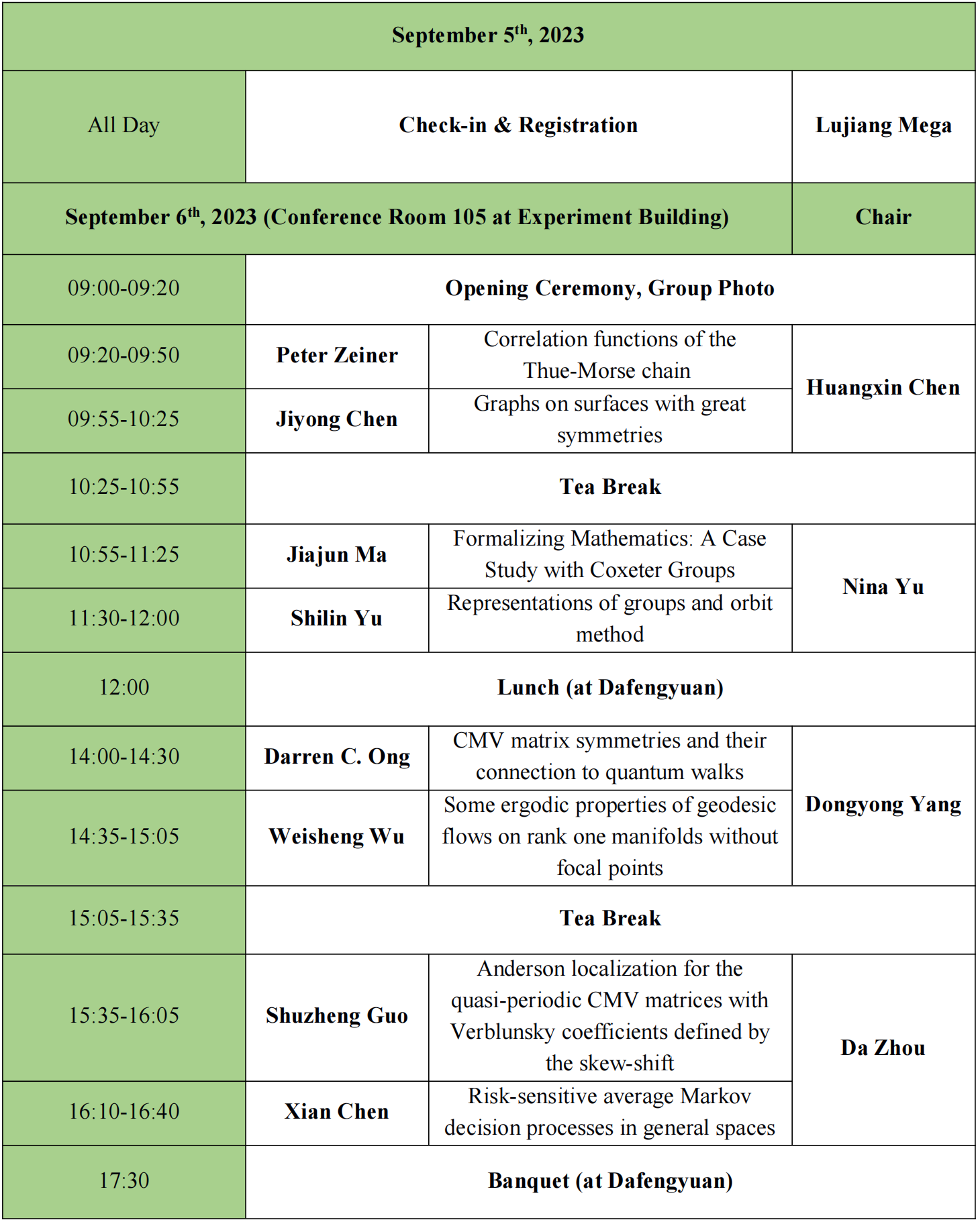
CMV matrix symmetries and their connection to quantum walks
Darren C. Ong(Xiamen University Malaysia)
CMV matrices are an important class of unitary operators on \ell^2(\mathbf Z). Recently it has been discovered that these CMV operators are useful for understanding quantum walks, the quantum mechanical analogue of random walks. In this talk we discuss how symmetries of these CMV operators help us understand important properties of some quantum walk models, for example the "mobility edge" phenomenon where we observe transition from pure point to continuous spectrum when we vary the spectral parameter.
This is joint work with Christopher Cedzich, Jake Fillman, Long Li and Qi Zhou.
Correlation functions of the Thue-Morse chain
Peter Zeiner(Xiamen University Malaysia)
The Thue-Morse chain is a well-known aperiodic sequence and an important model to study aperiodic systems. In this talk, we focus on its autocorrelation function and discuss some generalisations to n-point correlation functions. The correlation function satisfies certain recurrence relations which allow us to derive some explicit formulas for the n-point correlation functions. Furthermore, they allow us to investigate their symmetries and some asymptotic properties. Finally, we derive some bounds for the autocorrelation function and the asymtotic growth rate of its summatory function. This is joint work with Darren Ong, Chang Wen Teng and Tio Ru Chen.
Anderson localization for the quasi-periodic CMV matrices with Verblunsky coefficients defined by the skew-shift
Shuzheng Guo(Ocean University of China)
In this talk, quasi-periodic CMV matrices with Verblunsky coefficients given by the skew-shift is considered. We obtain the positivity of Lyapunov exponents and Anderson localization for almost all frequencies and large coupling parameter, which establish the analogous results of one-dimensional Schr\"{o}dinger operators proved by Bourgain, Goldstein and Schlag. (Joint work with Yanxue Lin and Daxiong Piao.
Formalizing Mathematics: A Case Study with Coxeter Groups
Jiajun Ma(Xiamen University)
In recent years, significant progress has been made in the formalization of mathematics. The prime example of this development is the Lean, a proof verification tool led by Microsoft, and Mathlib, a library of mathematical definitions and theorems initiated by Kevin Buzzard in 2017. The Mathlib project gained significant recognition through Peter Scholze's The Liquid Tensor Experiment and Buzzard's plenary talk at ICM2022.
Graphs on surfaces with great symmetries
Jiyong Chen(Xiamen University)
A map is an embedding of a graph on a surface. The theory maps is an old, well-established but also vibrant branch of combinatorics. There are some classical results and famous problems in this area, such as the Euler formula and the Four Color Theorem. In this talk, I will discuss maps with great symmetries from two different aspects: given graphs and given surfaces.
Representations of groups and orbit method
Shilin Yu (Xiamen University)
The concept of groups captures symmetries of mathematical and physical objects, such as regular polygons in geometry, the roots of an equation in algebra, space-time in special relativity and molecules in chemistry. Representation theory of groups studies group structures by representing their elements of as linear transformations of vector spaces. A Lie group, named after the Norwegian mathematician Sophus Lie, is a group of symmetries where the symmetries are continuous. Unitary representations of Lie groups, which are representations with extra analytical structures, are of great importance in geometry, number theory and particle physics. They are far from being completely classified.
The "coadjoint orbit method" philosophy of Kirillov and Kostant suggests that there is a close connection between irreducible unitary representations of a Lie group G and the coadjoint orbits in the linear dual of its Lie algebra. Roughly, one expects that the representations arise as "quantizations" of coadjoint orbits, which is the analogue of the process going from classical mechanics to quantum mechanics in physics. We will introduce basic notions in representation theory and coadjoint orbit method and discuss recent developments. The talk is based on a joint paper with Conan Leung and an ongoing joint work with Ivan Losev.
Some ergodic properties of geodesic flows on rank one manifolds without focal points
Weisheng Wu(Xiamen University)
We consider some ergodic properties of geodesic flows on rank one manifolds of nonpositive curvature and without focal points. Firstly, I will present the ergodicity of Liouville measure under a condition for rank one surfaces without focal points. Then we discuss uniqueness of measure of maximal entropy and the problem of counting closed geodesics.
Risk-sensitive average Markov decision processes in general spaces
Xian Chen(Xiamen University)
We study discrete-time Markov decision processes with Borel state and action spaces under the risk-sensitive average cost criterion. The cost function can be unbounded. We introduce a new operator and prove the quasi-compactness of the operator from which the multiplicative Poisson equation is derived. Moreover, we develop a new approach to show the existence of a solution to the risk-sensitive average cost optimality equation and obtain the existence of an optimal deterministic stationary policy. Furthermore, we give two examples to illustrate our results. This is a joint work with Qingda Wei.